
- Chinese: Business Department 0539-8782638
- English: chau@dengzhuochem.com
- Chinese: Business Department 0539-8782638
- English: chau@dengzhuochem.com
How Isomerization Catalysts Improve Fuel Quality Without Changing Molecular Size
2026-09-23
In refining and petrochemicals, there is a class of reactions that achieves remarkable results without changing the size of the molecules involved. These reactions are called isomerization. They take a molecule and rearrange its atoms into a different shape, while keeping the same number of carbon atoms. The result is a product with the same molecular weight but very different properties—higher octane, better cold-flow behavior, or a more valuable chemical structure.
The catalysts that make this possible are among the most important in the industry. And at the heart of many of them is a zeolite.
Why Isomerization Matters
To understand why isomerization is so valuable, consider two examples from everyday fuels.
Gasoline quality is measured by octane number. Straight-chain paraffins—like normal pentane and normal hexane—have low octane numbers. When you rearrange them into branched isomers, the octane number rises significantly. Iso-pentane and iso-hexane burn more smoothly in an engine than their straight-chain counterparts. This is why isomerization is a key process in refineries that want to produce high-octane gasoline without adding aromatic compounds or other additives.
Diesel fuel faces the opposite problem. Straight-chain paraffins in diesel have excellent cetane numbers, but they crystallize at low temperatures. In cold weather, these wax crystals can clog fuel filters and stop the engine. Isomerization converts some of those straight-chain molecules into branched ones. Branched paraffins do not crystallize as easily, so the diesel keeps flowing in winter. The cetane number drops slightly, but the cold-flow improvement is often worth the trade-off.
A third example comes from petrochemicals. Xylene exists in three isomers: para-xylene, meta-xylene, and ortho-xylene. Only para-xylene is the desired feedstock for producing PET plastic and polyester fiber. The other two isomers are less valuable. An isomerization catalyst can convert meta- and ortho-xylene into para-xylene, allowing the refinery to recycle the undesired isomers back into the valuable product.
The Catalyst: A Metal on an Acidic Support
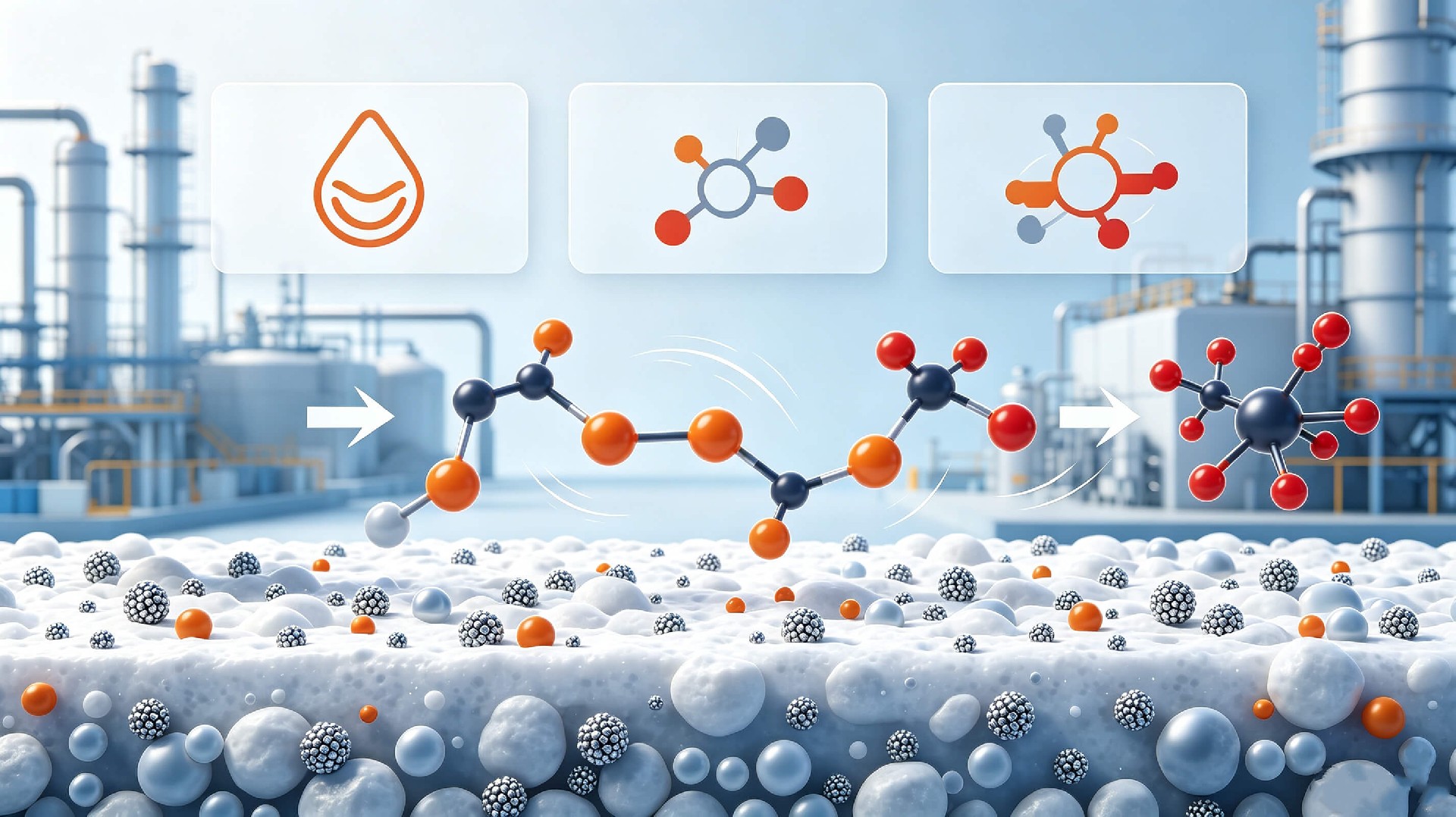
The typical isomerization catalyst is a bifunctional material. It has two types of active sites working together: a metal site and an acid site.
The metal site—often platinum or palladium—performs a dehydrogenation step. It removes hydrogen from the hydrocarbon molecule and creates an olefin intermediate. The acid site—provided by the zeolite—then rearranges the carbon skeleton of that intermediate. Finally, the metal site adds hydrogen back to form a stable, branched paraffin.
The zeolite is not just a passive acid provider. Its pore structure plays a critical role. ZSM-5 has medium pores that favor the formation of specific branched isomers while limiting unwanted cracking. Beta zeolite has larger pores that allow bulkier molecules to enter and react. MCM-22 has a unique pore system with both internal channels and external pockets, giving it unusual flexibility for reactions involving molecules of different sizes. For diesel dewaxing, one-dimensional zeolites like ZSM-22 and ZSM-23 are often chosen because their narrow channels favor isomerization over cracking.
Industrial Applications
Isomerization catalysts serve three major industrial purposes.
In light naphtha isomerization, the feedstock is a mixture of C5 and C6 paraffins from crude oil distillation. The catalyst converts straight-chain molecules into branched ones, boosting the octane number of the gasoline pool. This process is particularly important in regions where aromatic content in gasoline is restricted.
In xylene isomerization, the feedstock comes from catalytic reforming or toluene disproportionation. The catalyst rearranges meta- and ortho-xylene into para-xylene, which is then separated and sold to the polyester industry. The remaining isomers are recycled back through the reactor.
In catalytic dewaxing, the feedstock is a diesel or lubricant base oil fraction containing waxy straight-chain paraffins. The catalyst selectively isomerizes those wax molecules into branched ones, lowering the pour point and cold filter plugging point. This allows refiners to produce winter-grade diesel and high-quality lubricants without solvent dewaxing.
What Makes a Good Catalyst
Several factors determine how well an isomerization catalyst performs. The balance between metal and acid sites is critical—too much acid leads to cracking and unwanted light gases, while too little acid gives poor isomerization activity. The pore structure of the zeolite controls which molecules can enter and what products can form. And the catalyst must resist deactivation by coke, sulfur, and water over long operating cycles.
Recent developments have focused on improving diffusion within the catalyst particles. Mesoporized zeolites—materials with larger pores added to the conventional micropore network—allow reactants to reach active sites more easily and products to escape faster. This reduces cracking side reactions and extends catalyst life.
Summary
Isomerization catalysts are a quiet but essential part of modern refining and petrochemicals. They rearrange molecules without changing their size, producing higher-octane gasoline, more valuable xylene isomers, and diesel that keeps flowing in cold weather. The catalysts themselves are sophisticated bifunctional materials, combining a metal for hydrogen handling with a zeolite for acid-catalyzed rearrangement. For refineries looking to squeeze more value from every barrel, isomerization is a process worth understanding—and the catalyst is where the chemistry happens.
<< Previous Page
Next Page >>

- Chinese: Business Department 0539-8782638
- English: chau@dengzhuochem.com
Shandong Dengzhuo Chemical Co.,Ltd
We are looking forward to serve you as soon as possible. Please don't hesitate to contact us at any time,anything you need, be free to contact us. Sitemap
 0539-8782638
 17686900930
 chau@dengzhuochem.com
