
- Chinese: Business Department 0539-8782638
- English: chau@dengzhuochem.com
- Chinese: Business Department 0539-8782638
- English: chau@dengzhuochem.com
How Zeolite Catalysts Turn Waste Tires, Oils, and Plastics into Diesel Fuel
2026-08-10
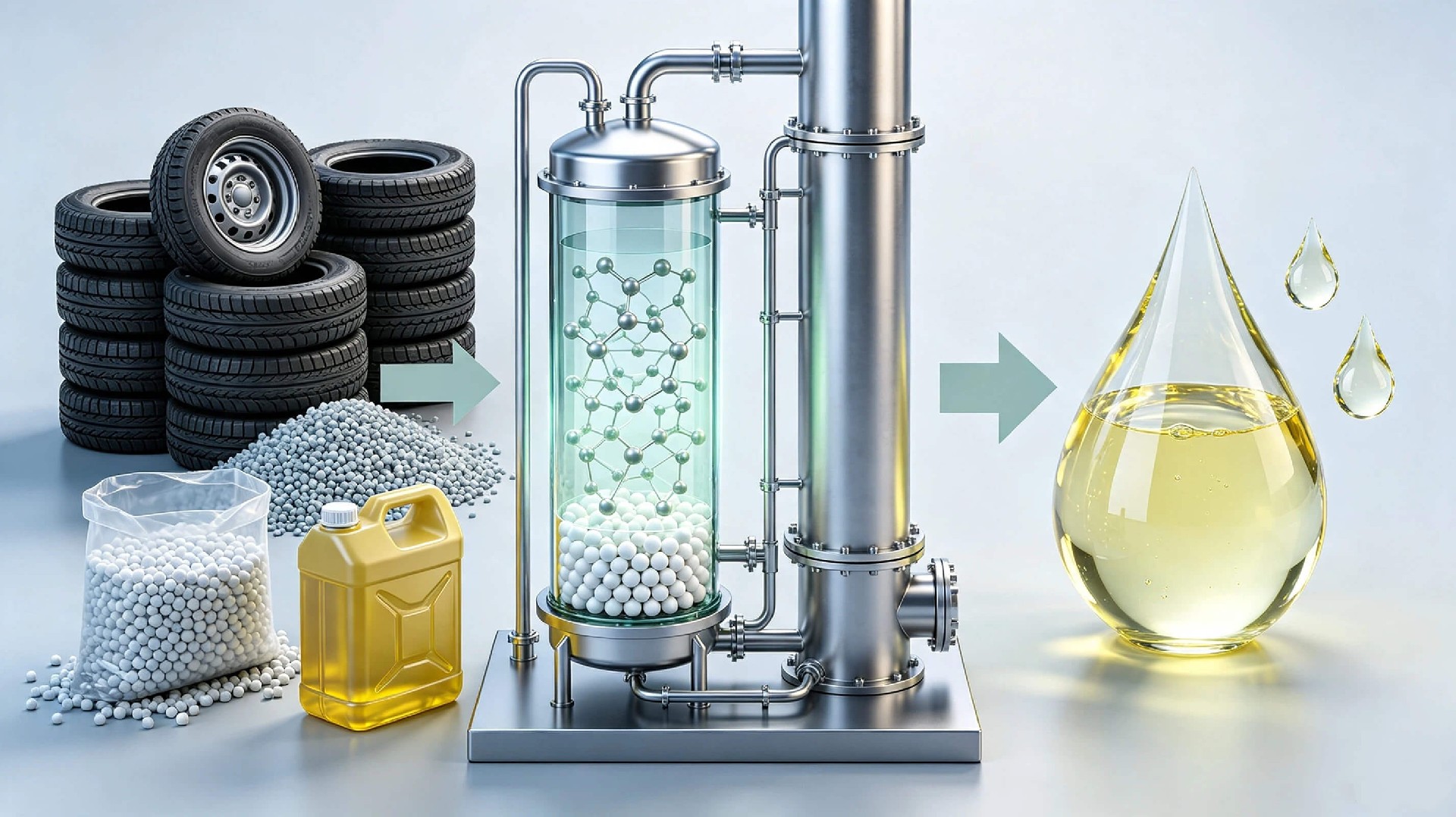
Every year, millions of tons of scrap tires, waste lubricating oils, and waste plastics end up in landfills or incinerators. These materials are not just a disposal problem. They represent a lost opportunity. They are rich in hydrocarbons—the same building blocks found in crude oil. With the right catalyst and the right process, these waste streams can be converted into valuable diesel-range fuels. The key to this conversion is catalytic cracking, and at its heart are ZSM-5 and USY zeolite catalysts.
Why Thermal Cracking Alone Is Not Enough
Scrap tires, waste oils, and waste plastics are chemically different from crude oil. Tires contain long polymer chains cross-linked with sulfur. Waste oils are contaminated with additives, metals, and degradation products. Plastics are made of high-molecular-weight polymers that do not flow or crack easily.
Thermal cracking alone—heating these materials without a catalyst—can break them down, but the products are often low-quality. Too much heavy residue, too many unwanted byproducts, and poor fuel properties. The process also requires higher temperatures and produces more coke. Zeolite catalysts change the equation. They provide acidic sites that weaken carbon-carbon bonds, making cracking occur at lower temperatures with better selectivity. Their uniform pore structures also favor the formation of diesel-range hydrocarbons (typically C10-C20) over lighter gases or heavy residues.
ZSM-5 and USY: The Right Zeolite for the Right Feedstock
Different zeolites offer different pore sizes and acidity levels, making them suitable for different waste streams.
ZSM-5 is a medium-pore zeolite with strong acidity. Its intersecting channel system (about 0.55 nm) is ideal for cracking the long hydrocarbon chains found in waste plastics and tire-derived oils. ZSM-5 promotes the formation of gasoline and diesel-range hydrocarbons while suppressing excessive coke formation. Studies have shown that modified ZSM-5 catalysts can achieve fuel oil yields of 70% or higher from waste plastics.
USY (ultra-stable Y) zeolite has larger pores (about 0.74 nm) and is particularly effective for cracking heavier molecules. Its spacious supercages can accommodate the bulky molecules found in tire-derived oils and heavy waste lubricants. Research has demonstrated that USY catalysts can achieve total liquid yields above 91% from waste plastics at 430°C, with diesel fraction yields reaching 33%.
In many commercial systems, these zeolites are used in combination. A two-stage approach is common: USY or REY zeolite in the first stage for primary cracking of large molecules, followed by ZSM-5, MCM-22, or Beta zeolite in the second stage for isomerization and aromatization to improve fuel quality.
How the Process Works and What It Can Handle
The catalytic cracking of waste feeds is typically carried out in distillation-based equipment that integrates vaporization, catalytic reaction, and product fractionation. The basic process follows these steps. First, the waste feed is cleaned of gross contaminants like metals, water, and dirt. Next, the cleaned feed is heated to 350-500°C in a distillation vessel, generating hydrocarbon vapors. The vapors then pass through a fixed-bed reactor packed with zeolite catalyst, where the large molecules crack into smaller, diesel-range hydrocarbons. The cracked vapors are then condensed and distilled into product fractions—typically naphtha (gasoline range), diesel, and heavy fuel oil.
Like all cracking catalysts, zeolites gradually deactivate due to coke deposition. They can be regenerated by controlled oxidation to burn off the coke, restoring activity. Modern systems are designed for continuous operation, with multiple reactors allowing one bed to be regenerated while others remain on-stream.
Scrap tires are one of the most challenging waste streams. They contain natural and synthetic rubber, carbon black, steel, and sulfur compounds. Pyrolysis of tires produces a heavy oil rich in aromatics but also containing sulfur and heavy residues. Catalytic cracking over ZSM-5 and USY zeolites upgrades this tire-derived oil into lighter, more valuable fractions.
Used engine oils contain valuable hydrocarbons, but they are contaminated with additives, wear metals, soot, and oxidation products. Direct distillation without catalysis produces poor-quality fuel with high sulfur and metal content. Zeolite-based catalytic cracking offers a cleaner path. When waste lubricating oil is vaporized and passed over a zeolite catalyst in a fixed-bed reactor at 380-430°C, the long hydrocarbon chains crack into diesel-range molecules.
Mixed waste plastics, particularly polyolefins like polyethylene and polypropylene, are ideal feedstocks for catalytic cracking. These plastics are essentially pure hydrocarbons with high energy content. However, without a catalyst, thermal pyrolysis produces a wide distribution of products, including heavy waxes that are difficult to use. ZSM-5 zeolite selectively cracks the long polymer chains into diesel and gasoline-range hydrocarbons. In optimized conditions, modified ZSM-5 catalysts have achieved fuel oil yields of 70% or more.
Summary
ZSM-5 and USY zeolite catalysts are the workhorses of waste-to-fuel conversion. They enable the efficient cracking of scrap tires, waste lubricating oils, and waste plastics into valuable diesel-range fuels. Their unique combination of acidity, shape selectivity, and thermal stability makes them the preferred choice for operators looking to turn waste streams into revenue. As pressure to reduce waste and recover resources continues to grow, zeolite-catalyzed cracking will play an increasingly important role in the circular economy.
<< Previous Page
Next Page >>

- Chinese: Business Department 0539-8782638
- English: chau@dengzhuochem.com
Shandong Dengzhuo Chemical Co.,Ltd
We are looking forward to serve you as soon as possible. Please don't hesitate to contact us at any time,anything you need, be free to contact us. Sitemap
 0539-8782638
 17686900930
 chau@dengzhuochem.com
