
- Chinese: Business Department 0539-8782638
- English: chau@dengzhuochem.com
- Chinese: Business Department 0539-8782638
- English: chau@dengzhuochem.com
Hydrotreating Catalysts: Removing Sulfur for Cleaner Fuels
2026-06-22
Most of the fuel we use comes from crude oil. But crude oil contains sulfur. Sulfur causes problems. It creates pollution when burned. It poisons other catalysts in the refinery. It also makes products unstable and gives them a bad smell. Removing sulfur is the job of hydrotreating catalysts. They are among the most widely used catalysts in the refining industry.
What Is Hydrotreating?
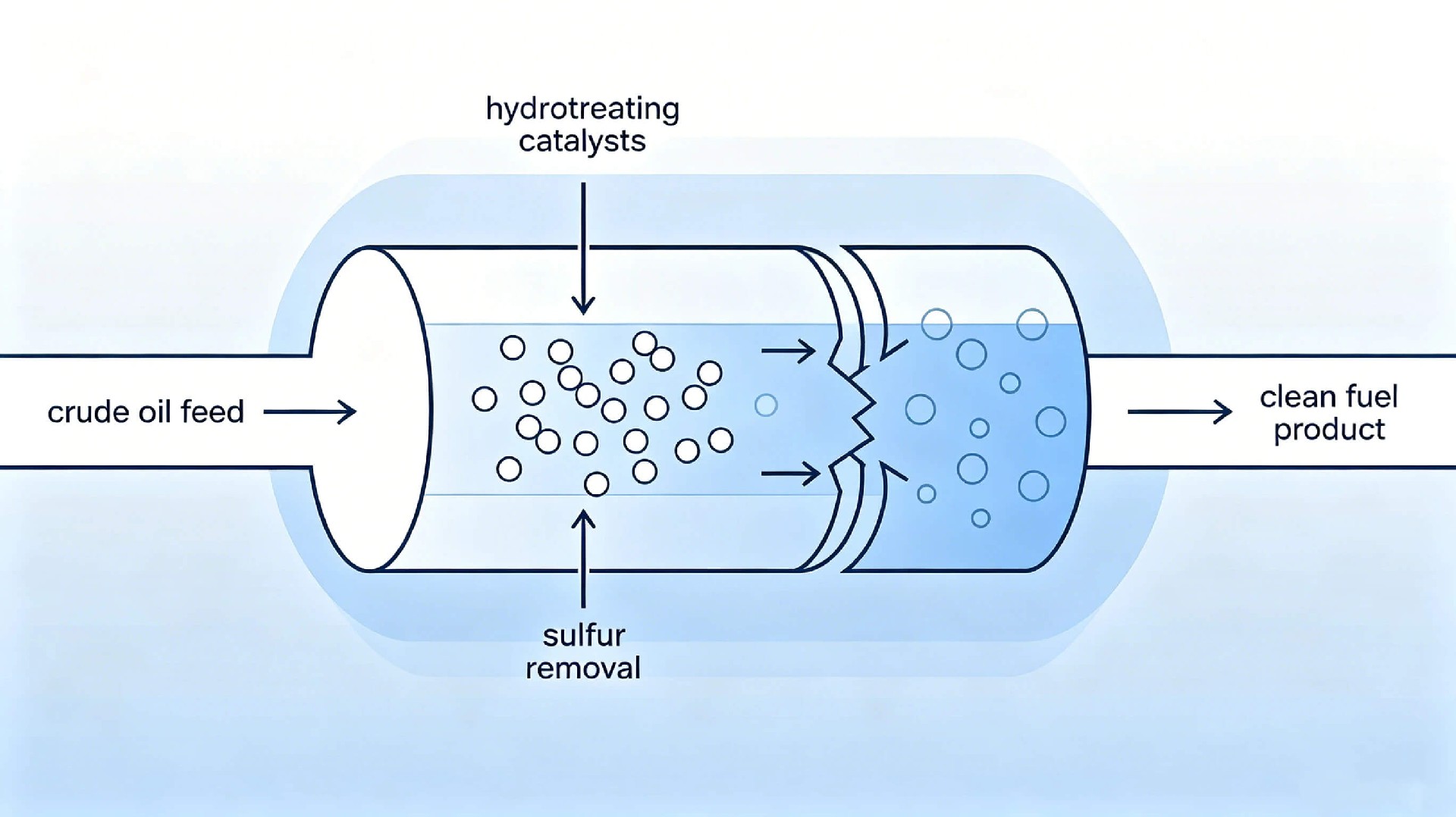
Hydrotreating is a process that treats petroleum fractions with hydrogen in the presence of a catalyst. The main goal is desulfurization—removing sulfur as hydrogen sulfide (H₂S). The process also saturates olefins (removing gum-forming compounds) and improves product stability.
The operating conditions are moderate. Typical temperatures range from 300 to 400°C. Pressures range from 20 to 100 bar, depending on the feedstock and the required product quality.
The Two Main Catalysts: CoMo and NiMo
Two catalyst families dominate hydrotreating. Both use alumina as the carrier.
Cobalt-molybdenum (CoMo) catalysts are the standard choice for removing sulfur. They are highly active for hydrodesulfurization (HDS) and work well with cleaner feedstocks like naphtha and diesel.
Nickel-molybdenum (NiMo) catalysts are also used for desulfurization. They are especially effective with heavier, dirtier feedstocks that contain more sulfur and other impurities. NiMo catalysts also hydrogenate aromatics more effectively than CoMo.
In practice, many refineries use CoMo for lighter streams and NiMo for heavier streams.
The active ingredients are not the metals themselves. The catalysts are sulfided before use. The actual active phase is a mixture of molybdenum sulfide (MoS₂) promoted by cobalt or nickel atoms. This sulfided form is what creates the active sites for removing sulfur.
What Affects Catalyst Performance?
Feed quality. Heavier feedstocks contain more sulfur. They require more catalyst volume and more severe conditions.
Space velocity. The speed at which the feed passes through the reactor affects desulfurization. Lower space velocity gives more contact time and better sulfur removal.
Hydrogen partial pressure. Higher hydrogen pressure improves sulfur removal. It also helps suppress coke formation on the catalyst.
Temperature. Higher temperature increases conversion, but it also accelerates catalyst deactivation through coking.
Catalyst life is a key economic factor. Typical hydrotreating catalysts last 1 to 3 years before replacement. Heavy gas oil units may last only 1 year. Naphtha units can last 5 years or more. The main deactivation mechanisms are coking (carbon deposits blocking pores) and metal deposition (nickel and vanadium from the feed accumulating on the catalyst).
Practical Considerations for Plant Operators
Sulfiding is the first step after loading fresh catalyst. The catalyst must be converted to its active sulfide form before oil is introduced. This is usually done with a sulfiding agent like dimethyl disulfide.
Startup and shutdown require careful temperature control. Rapid changes can damage the catalyst. Typical ramp rates are 10-20°C per hour.
Grading is the practice of using different catalyst sizes or types in layers. Larger particles at the top catch metals and debris. Smaller particles at the bottom do the fine desulfurization. This extends overall catalyst life.
Regeneration is possible for catalysts deactivated by coke. The carbon is burned off in a controlled oxygen environment. But regeneration does not remove metal deposits. Once metals reach a certain level, the catalyst must be replaced.
Hydrotreating catalysts are essential for producing clean fuels. CoMo catalysts handle sulfur removal efficiently. NiMo catalysts work better with heavier, high-sulfur feedstocks. Both help refineries meet strict environmental specifications for diesel, jet fuel, and gasoline. Understanding how to select, operate, and maintain these catalysts directly impacts product quality, run length, and profitability.
<< Previous Page
Next Page >>

- Chinese: Business Department 0539-8782638
- English: chau@dengzhuochem.com
Shandong Dengzhuo Chemical Co.,Ltd
We are looking forward to serve you as soon as possible. Please don't hesitate to contact us at any time,anything you need, be free to contact us. Sitemap
 0539-8782638
 17686900930
 chau@dengzhuochem.com
